All Nonfiction
- Bullying
- Books
- Academic
- Author Interviews
- Celebrity interviews
- College Articles
- College Essays
- Educator of the Year
- Heroes
- Interviews
- Memoir
- Personal Experience
- Sports
- Travel & Culture
All Opinions
- Bullying
- Current Events / Politics
- Discrimination
- Drugs / Alcohol / Smoking
- Entertainment / Celebrities
- Environment
- Love / Relationships
- Movies / Music / TV
- Pop Culture / Trends
- School / College
- Social Issues / Civics
- Spirituality / Religion
- Sports / Hobbies
All Hot Topics
- Bullying
- Community Service
- Environment
- Health
- Letters to the Editor
- Pride & Prejudice
- What Matters
- Back
Summer Guide
- Program Links
- Program Reviews
- Back
College Guide
- College Links
- College Reviews
- College Essays
- College Articles
- Back
Roger
At 7:30 in the morning Roger’s clock radio turned on. It was set to a classical music channel. It was very loud. Roger turned over, away from the radio, towards the window and half opened his eyes. It was no longer dark out, but not quite light either. It was as if the sun had turned blue and all the buildings looked faintly like ice, or sky. It came to him slowly that he’d heard the song on the radio before. It was quick and full of flutes. He tried to remember its composer, but admittedly had no idea. He knew next to nothing about classical music.
Roger’s toast was black. He ate it anyway. Roger hated eating breakfast, but it didn’t matter so much anymore. Not like when he was a kid. His mother had always made him eat before he walked to school. Sometimes she would get too frustrated and simply give up, and Roger would stumble over the hills and roads to school and feel weak and tired, and wish he’d eaten breakfast. But that had happened so often it wasn’t really a problem. At least, Roger didn’t consider it one. But now he couldn’t taste his breakfast, and he felt empty whether he ate it or not, so it had become a non-issue. He could almost laugh at that.
Roger’s clothes were folded neatly in the dresser opposite his bed. The dresser was yellow. All the clothes inside were folded and sorted with extraordinary neatness. Roger prided himself on, if nothing else, his folding abilities. Three times every two weeks Roger took his clothes back from the laundromat and laid them out on the same table he ate breakfast on. Then he turned on the television and folded all the shirts and set them in one pile, and then went on to the pants and set them in a separate pile, and the rest of his clothes he stuffed in the upper drawer. The shirts went in the drawer below that, and the pants below the shirts. Roger didn’t watch the television as he folded. He just liked to hear the voices.
At 8:30, Roger was in his car on the way to work. All around him was smog, a mixture of morning mist and car exhaust. A sharp honking came from far ahead, over the metal horizon beyond which he couldn’t see. He reached for his coffee and tapped the steering-wheel mindlessly, humming the song he’d heard on the radio that morning, trying to remember the names of composers he’d learned about in middle school band. There was Vivaldi, and Beethoven, and Mozart, and a woman who wrote church hymns whose name he couldn’t remember, but he doubted any of them had written the song.
Roger worked downtown in a tall building made half of glass, half of concrete. His cubicle was about three-quarters up the building, adjacent to the walkway which led between the cubicles from the big doors of his manager’s office to the windows. Sometimes, Roger would lean out into the walkway and look down at the city, half-obscured by mist, but most often he would stare over his cubicle wall and try to see, through the windows, the occasional plane passing by.
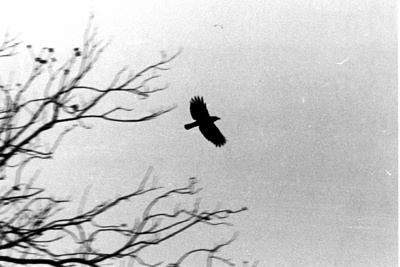
He had never, however, seen a bird that high. He wondered if birds could fly that high at all. He tried to imagine how a bird might see him, staring out from behind his cubicle, so small and so sad. But then he thought that the bird probably wouldn’t care. It didn’t care about anything but food and water and sleep. Roger envied that.
After work was over, Roger hiked back to the parking garage several blocks from his building and began the drive home. There was something comforting in the routine of his day, Roger thought, but also something deeply unsettling. Almost unnatural. He felt caged. But he couldn’t remember a time in his life when he didn’t feel caged, so he had nothing to compare it to. So it didn’t matter.
And then Roger came to a particular light. It was the light that was always red when he got to it, that took (and he had counted many times) a full minute to turn, that he hated more than anything else on his drive home. And Roger was angrier than usual that day. Work had been bad – an error in the company’s system had been blamed on him for no good reason. If there was one thing Roger hated more than that light on his drive home, it was unfairness. And as he sat at the light, he got madder and madder, going through it all in his mind, over and over again. He felt the world was all against him. All of existence was conspiring to make him unhappy. He hated his job and he hated his life and he had done nothing to deserve this. And Roger felt madder than he ever had before.
And so Roger made the first impulsive act of his life.
He ran the light.
The cars behind him bellowed as he careened through the intersection. Roger swung into the next side street and side-first into a streetlight. A spider-web of cracks spread along his car’s right window. He sped as far as he could away from the main road. Finally, when he felt he had gone a good enough distance, he pulled into an empty sand lot and slid his hands off the steering wheel. He was panting, covered in sweat. His impulsiveness had completely left him.
For a moment, Roger was seized with terror at the thought of being found out. He pictured himself back at his apartment, putting something in the microwave, hearing a knock on the door and opening it to flashing lights and brusque shouts. Then he realized people ran lights all the time, and no one knew who he was anyway. Calming himself with this thought, Roger rolled out of the lot and drifted quietly back to the main road.
But when Roger turned back onto the road he noticed something peculiar: there was nobody about. Where only a few minutes ago surged a sea of roaring engines there now reigned pure silence. Examining the various shops and offices along the road, Roger found them deserted as well. It was nearly dusk. He had never stayed downtown this long before.
And in the total quiet of the empty street Roger felt an idea coming to him. It made him tremble to think of, and immediately he pushed it from his thoughts and got into his car and headed home. But all the way there Roger felt the idea turning in his brain, tempting him. His most perverse thoughts had no comparison to what he was now considering. But as he pictured it more and more vividly his heart began to pound, and he was filled with a vigor and excitement he had never known.
By the time he arrived back at his apartment, Roger was decided.
The next day after work, Roger, instead of rushing home as he usually would, pulled out of the parking garage and circled the town, taking in its sights and sounds, the grayness and the bleakness of it all. And finally when the streets were clear, Roger pulled his car into the middle of the intersection which he hated so much, under the light that he could never get past, and stepped out and breathed in the fog. Silence.
Through the city he went, leaping, hollering, smashing the cars and windows he’d passed before, taking nothing. He broke the ghost town, left it all to waste. He did this in the vaguely orange light of the flickering streetlamps, barely visible on the pavement, red and laughing and paranoid. And then, by chance, as he rounded one particular corner, he caught a glimpse of his reflection in the darkened windows across the street.
Roger was a portly man, not overly so but noticeably nonetheless. His suit and pants were matching, gray as his hair, which was rapidly disappearing from his scalp. His head itself was long, and wider at the bottom. His nose in contrast was thin, sloped and pointing. His eyes sagged, an indeterminable mix of green and blue, so unremarkable.
Those eyes were wide with sad incomprehension. He was forty-six years old.
Roger noticed then that his tie had come loose, and reached up to tighten it, and watching himself in the windows a great burst of shame came over him. And he turned to run, then thought better and began to walk, quickly, back to his car, and when he reached it he shut and locked the doors and rolled up the windows and drove away, through the new darkness, down that same street he always took.
When Roger arrived at work the next day no one acted any differently towards him. No one looked at him with suspicion. No one looked at him at all. And Roger didn’t look at them either. He sat at his cubicle as he always did and swiveled to look out over the wall through the windows as he always did. And for the first time he saw a bird. Flying up as high as the airplanes. He watched it glide by until it dipped down below the clouds and he could make it out clearer and clearer as it drew nearer to the windows, and then it closed its wings and dove and Roger lost sight of it.
And he turned back to his desk and wept.
Similar Articles
JOIN THE DISCUSSION
This article has 0 comments.