All Nonfiction
- Bullying
- Books
- Academic
- Author Interviews
- Celebrity interviews
- College Articles
- College Essays
- Educator of the Year
- Heroes
- Interviews
- Memoir
- Personal Experience
- Sports
- Travel & Culture
All Opinions
- Bullying
- Current Events / Politics
- Discrimination
- Drugs / Alcohol / Smoking
- Entertainment / Celebrities
- Environment
- Love / Relationships
- Movies / Music / TV
- Pop Culture / Trends
- School / College
- Social Issues / Civics
- Spirituality / Religion
- Sports / Hobbies
All Hot Topics
- Bullying
- Community Service
- Environment
- Health
- Letters to the Editor
- Pride & Prejudice
- What Matters
- Back
Summer Guide
- Program Links
- Program Reviews
- Back
College Guide
- College Links
- College Reviews
- College Essays
- College Articles
- Back
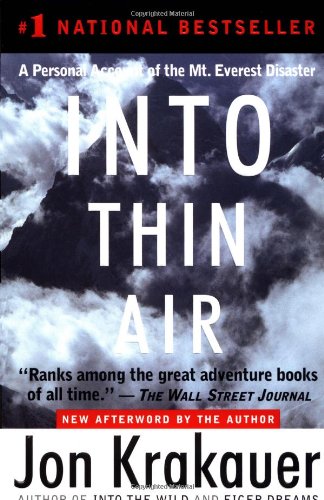
Into Thin Air by Jon Krakauer MAG
In this compelling story, Into Thin Air, Jon Krakauer tells the story of the worst disaster on Mount Everest's rigid slopes since it was first climbed by Sir Edmund Hillary in 1953. A total of 15 people died in 1996 trying to reach the summit.
Krakauer was assigned by Outside Magazine to climb Everest and write about the disaster and its growing commercialism of Everest that summiting had become attainable by any wealthy tycoon who could pay to be shepherded by the Sherpas and experienced climbers as guides. The mountain had become crowded and lost its mystic of being one of the world's hardest climbs.
One reason for the 1996 disaster is that the guides pushed their clients to the summit even when conditions were far from ideal. Because of the sheer numbers attempting to summit, traffic jams often caused climbers to return from the top much later than was safe.
Krakauer is an excellent writer who uses descriptive language to paint a scene so vividly that readers will have no problem visualizing what he is trying to get them to see. His realistic tone also leaves no doubt of the facts and provides a moving and factual description.
For instance, Krakauer reflects on how the Everest disaster continues to affect him: “Mortality had remained a conveniently hypothetical concept, an idea to ponder in the abstract. Sooner of later the divestiture of such a privileged innocence was inevitable, but when it finally happened the shock was magnified by the sheer superfluity of the carnage.''
It is impossible to read Into Thin Air unmoved by the bad luck, worse judgment, and heartbreaking heroism.
Similar Articles
JOIN THE DISCUSSION
This article has 1 comment.
19 articles 0 photos 85 comments
Favorite Quote:
"What's in a name? That which we call a rose by any other name would smell as sweet". Romeo and Juliet ( Quote Act II, Sc. II).<br /> <br /> "Let them eat cake."<br /> Marie Antoinette